Introduction:
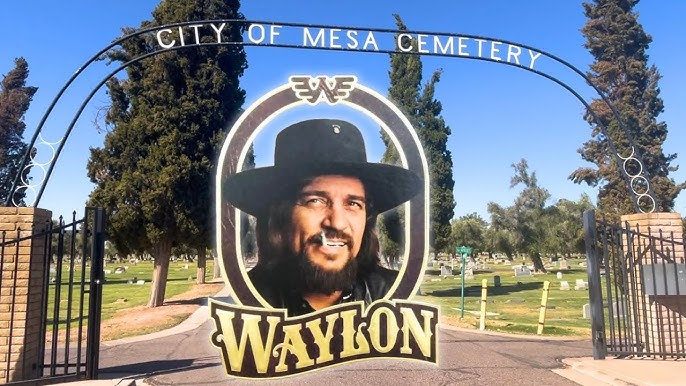
In the quiet desert town of Mesa, Arizona — far removed from Nashville’s glittering lights and the thunder of concert stages — lies the final resting place of Waylon Jennings. His grave is marked by a simple headstone, modest to the eye, yet carrying the gravity of a man who forever altered the course of country music. To those who know his story, that stone is no mere marker. It is a monument to a life defined by grit, rebellion, and a relentless pursuit of truth.
The cemetery itself is serene, bathed in the golden glow of the desert sun. Sparse greenery sways in the warm breeze, and shadows stretch long across the earth. It is a fitting scene — unadorned, honest, and without spectacle — mirroring the man who never cared for polish but always demanded authenticity. Visitors who journey here leave behind flowers, guitar picks, handwritten notes, or lyrics scribbled on scraps of paper. Each offering is a quiet thank-you for songs like Luckenbach, Texas, Good Hearted Woman, and Are You Sure Hank Done It This Way. To fans, these weren’t just hits; they were lifelines, guiding lights for those who believed in freedom, individuality, and the courage to live by their own compass.
Standing before his grave, it isn’t hard to imagine the sound of Waylon’s unmistakable, gravel-edged voice echoing through the desert air — questioning authority, rejecting convention, and telling hard truths that the industry often tried to ignore. Jennings was more than a performer. He was a cornerstone of the Outlaw Country movement, alongside Willie Nelson, Johnny Cash, and Kris Kristofferson in the legendary Highwaymen. Together, they broke down barriers and proved that country music could be raw, unfiltered, and fiercely independent. Waylon didn’t just sing about freedom — he lived it, often at great personal cost.
His grave, however, is not only a place of mourning. It has become a sanctuary of respect — a quiet gathering place where fans come to honor and celebrate a man who refused to compromise. Under Arizona’s vast sky, his presence lingers in every chord strummed on an old guitar, every lyric remembered in a late-night drive, every story shared about how his music helped someone through their darkest hours.
Waylon Jennings’ fight for authenticity was never easy, but it is precisely that struggle that makes his legacy timeless. His resting place is not the end of his story — it is a reminder that true artistry endures, and that a life lived with conviction leaves a mark no amount of time can erase.
In Mesa’s stillness, his outlaw spirit feels alive, riding the desert wind like a familiar song carried from one generation to the next. For those who stand before that humble headstone, it is more than a visit to a grave. It is a communion with a man whose music refuses to fade — a man whose voice will always ride alongside us on the long, open road.